I rarely share personal updates. But as the seasons change, I often find it helpful to mark them with words. Writing is a way for me to process my thoughts and discover what I truly think about a subject or situation. So, this post is likely more for me than you.
I just turned 39. I just reenrolled in seminary. I have both an eagerness to begin and a hopefulness that I’ll meet God in some exciting new ways.
To begin with, I have an insatiable desire to learn, and I generally experience a heightened sense of joy and God’s presence while learning about him and the world he created. Seminary is fertile ground for curious people. Yet, in many ways, this journey feels less like gardening and more like returning to a workbench to complete an unfinished task. I’ve been away awhile and am trying to recall what was left undone and what tools are needed to accomplish the job.
Let me back up to my first seminary experience.
In 2014, my wife and I moved to Denver, Colorado, so I could pursue a Master of Divinity degree at Denver Seminary. We had a set of twins in diapers, no money, no job, but a dream in our hearts and a call on our lives. I prayed without ceasing while driving a U-Haul across Missouri and Kansas, headed for a new land. I was uncertain about the future but hopeful, ever so hopeful, about what God was up to.
Not long after arriving on campus, we welcomed our second set of twin daughters (yes, second, within eighteen months of each other)! We now had four babies in diapers. Thankfully, I was able to find a job washing cars and leading a group of high school students to assist in that process. My wife and I were blessed and slightly in over our heads.
The pressure on my time and mental capacity was great in this season. You can likely imagine—full-time work to pay the bills and feed the family, coursework with the academic demands of graduate school, all while trying to prioritize my family because God says if we can’t lead our family, we have no business leading in the church (1 Timothy 3:5).
One semester, shortly after our second set of twins was born, I received D’s in both a theology class and a church history class because I simply couldn’t keep up with all the demands. I knew something was going to give, and it couldn’t be my family. It also couldn’t be my job because we had bills to pay. I dropped my classes midway through the semester and received D’s (cue the jokes about D’s making degrees or the word “degree” starting with the letter D).
It wasn’t long after that challenge that my declared MDiv was switched to an MA. I needed theological training, but the MDiv would have to wait.
There were various challenges in that season but also many blessings. Looking back, I’d say we were more fearful about some things and more confident in God about others. Life is like that, I suppose. There are daily obstacles but also new mercies every morning.
After stops in Fort Collins, CO, and Lee’s Summit, MO, to work at Trader Joe’s while finishing my coursework online, I eventually, by God’s grace, completed a Master of Arts degree in 2019. But I’ve always kept the dream of completing an MDiv in my heart. Now I’m 39 and returning to pursue the thing I originally set out to accomplish.
Starting Again
While 39 isn’t old (just ask someone further down the road), I’m not sure it can be defined as young, either (just ask someone much younger). But it feels like an interesting season to return to school, nonetheless.
Today, after spending several years in full-time vocational ministry, I have a different appreciation for seminary education. I have different questions—different curiosities. I know that my education will directly impact my ministry. As I preach and teach, homiletics and languages will enhance my ability to do so faithfully and accurately. As I care for the needs of a congregation, pastoral care classes will help me do so with the heart of a shepherd.
I’m grateful for the ability to pursue the MDiv entirely online. And while I’m convinced that living on campus and experiencing community is far preferable, I stand amazed that we live in a time where I don’t have to uproot my family or leave my church to pursue higher education.
I grew up in the generation that believed a degree was the path to a higher-paying job. While that may be true in certain fields of study, ministry is certainly not one of them. I have little hope that my financial situation will change with a more advanced degree. Seminary (and ministry) is a calling, not a means to wealth. In fact, nothing about my current job is likely to change once I have an MDiv. Yet I’m more convinced than ever that what I learn will prove helpful to my current work. I’m also mindful of the fact that spiritual formation happens in the midst of learning. Theological education has rewards far beyond material gains.
Why Denver?
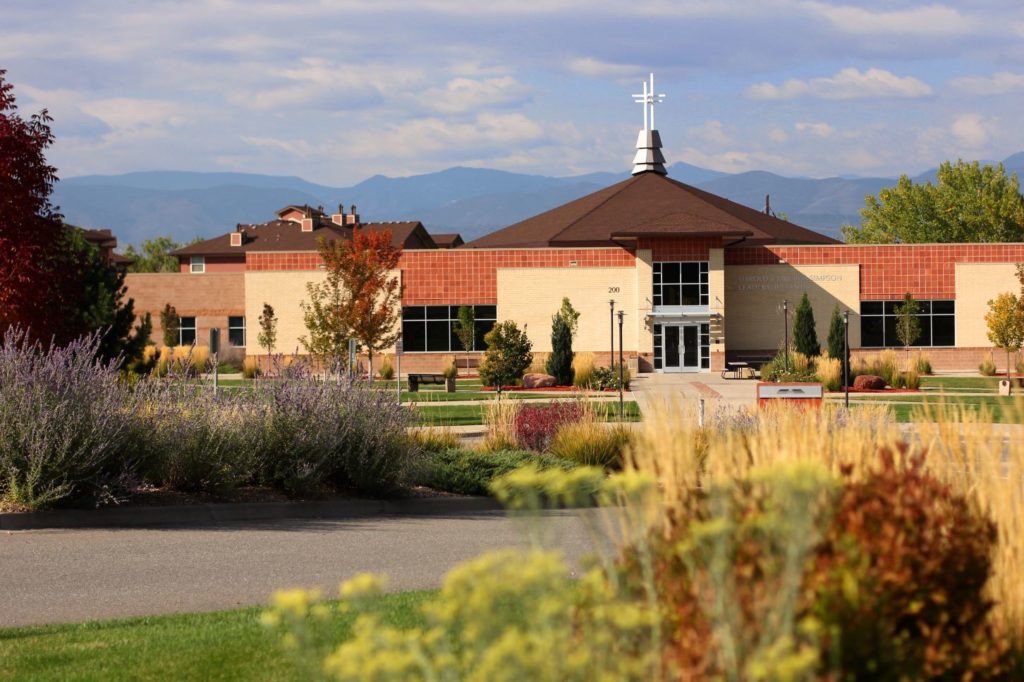
There are many great seminaries in the United States. Denver was one of a handful of serious options. But in complete transparency, I chose Denver Seminary initially and primarily because I wanted to live near the mountains. One of the greatest summers of my life happened while completing an internship in college and living in Estes Park, CO, with my wife, Rachel. That summer sealed the deal for me. I needed fresh mountain air.
I’ll never forget a conversation I had with a college professor. I told him I was strongly considering Denver Seminary but felt like it was a selfish pursuit because I wanted to live in the mountains. He smiled, and with a twinkle in his eye that exuded fatherly care, said, “I wouldn’t think of this move as a selfish pursuit. Perhaps God has planted the desire for mountains in your heart.” That was all I needed to apply.
The mountains were amazing, and the weather was the best I’ve ever experienced. But more than that stuff, I came to love two aspects of Denver Seminary that I’ve since adopted in my life and ministry.
First, I love Denver’s commitment to biblical authority. The school lives and breathes the Bible. It’s not just an ancient set of religious documents worth studying for history’s sake. Denver Seminary is committed to the inspiration, inerrancy, and authority of the Bible. In their own words, “The Bible forms the basis of our doctrinal statement and the centerpiece of our curriculum. We study the Bible and look to it as our authoritative reference, assessing theories and arguments for congruence with what it affirms.”
Second, I love Denver’s commitment to charitable orthodoxy. The school is broadly evangelical, allowing conversations to happen that may not take place in more rigid, strictly theological schools. I’ve been able to explore Christianity from multiple perspectives, majoring on the majors while wrestling with the minors in a kind and respectful way. I’ve had fruitful conversations with Anglicans, Presbyterians, Southern Baptists, and people from more eclectic or nondenominational tribes, all in the spirit of grace and truth. It’s refreshing.
I love this quote by the late Vernon Grounds, a legend at Denver Seminary, that describes the school’s ethos:
“Here is no unanchored liberalism—freedom to think without commitment. Here is no encrusted dogmatism—commitment without freedom to think. Here is a vibrant evangelicalism—commitment with freedom to think within the limits laid down in Scripture.”
Prayer
Father, thank you for the invitation to once again journey into the world of seminary. May I not take it for granted. May I embrace every page and lecture and conversation as a gift from you. Meet me on the journey. Help me be still and present to every moment.
In Jesus’ name.
Amen.






 Daniel Seabaugh
Leave a comment